

Tom Boswell Tree Surgeon is interviewed on Channel 5 News reporting the effects of Storm Boelo on UK Trees.
WHY IS THERE SUCH A PROBLEM WITH TREE FALLING AT THE MOMENT
1. Still very warm and so it’s late in the year and lots of trees still have their leaves on.
The leaves are creating a larger sail effect putting more stress through the roots of the trees.
2. Sodden water logged ground is making roots unstable
The heavy rain and flooding is making the roots unstable which combined with the high winds is making more trees unstable.
WHAT SHOULD YOU DO
1. Have your trees inspected regularly
Trees are valuable assets, but defects aren’t always obvious. Regular inspections by a suitably qualified, experienced and insured professional can help identify potential risks before they become serious problems.
2. Always use a professional tree surgery company
Tree surgery can be a high risk activity. It requires careful planning, appropriate equipment and properly trained, skilled personnel to ensure work is carried out safely.
3. Get trusted, independent advice
The Arboricultural Association provides excellent guidance on tree care, tree safety and choosing a professional contractor.
Visit www.trees.org.uk for more information.
At Tom Boswell Tree Services, we’re passionate about protecting and caring for trees while ensuring the safety of people and property.
If you’re concerned about the condition of your trees, or would like professional advice, please get in touch.
FULL TRANSCRIPT
INTERVIEWER
Do you see anything like this? Over the weekend, storm caused widespread damage and felled hundreds of trees. Right across the country, two people were killed after being hit by falling trees. A man in his 20s in north London and a 60 year old Richard Bailey in Dumfries and Galloway. And there’s more to come, with warnings over more high winds across much of the UK overnight and into tomorrow morning, and the risk from falling trees is much higher than normal.
Here to explain why is tree surgeon Tom Boswell. Great to see you. Tom, thanks for coming in. So? So why is it that more trees are falling now? Is it just because of the storms? Or is this something else?
TOM BOSWELL
Mostly because of the storm.
But there’s saturated ground as well, so it’s very wet for the trees to anchor into as well. So coupled with high winds, that causes a lot of a lot of push on the trees canopy that often got their their leaves at the moment as well. So it’s more of a sail effect. So it’s more likely to push the tree over and cause more extreme forces on it.
INTERVIEWER
Yeah. And what about the hot weather in the summer? Does that play? Has that played a role in weakening the trees?
TOM BOSWELL
It has. I think that will probably come over the next 12 to 18 months. You’ll see probably older trees, certainly native trees suffering a lot more because of that. It absolutely would contribute to the stress the trees are feeling at the moment. But I think this localized or immediate storm that’s happened the last couple of days is, you know, mainly the saturated ground really, that’s caused that and the high winds.
INTERVIEWER
Yeah. I mean, she’s lovely. When I saw this story coming out, I thought it was great. I really I love trees and I just think they’ve put a smile on people’s faces, whether they’re in the summer with loads of leaves on them or even in the winter. I think it can just really make your street come alive. Losing trees is sad.
What can people do to help you help the trees? Or is it just, you know, it’s a storm. It’s going to blow?
TOM BOSWELL
I mean, yes, you know, the storm will take perfectly healthy trees if it’s extreme conditions. And like I say, the ground underfoot is very wet and damp or very saturated, shall I say. But best thing you can probably do is to contact a professional. Go to our trade body, the Arbor Cultural Association. So fancy word for trees basically, but trees.
I think I’ve got that right. They will put you in touch with a registered professional, professional companies such as ourselves who will be able to inspect your trees. It might be every year, it might be every three years depending on the location. But they will give you advice and point in the right direction for how to maintain your trees safely and inspect them properly as well.
Yeah, well, you might be able to inspect some of these people that have been getting in touch, sending us pictures of their trees. Joe’s watching from Somerset. He sent us this picture. He’s absolutely devastated to see his neighbor’s weeping willow succumb to the storm over the weekend. I mean, weeping Willow, they just. You can tell when you’re standing underneath one.
INTERVIEWER
They catch the wind in a big way, don’t they? And some more shocking photos sent in from Carol in West Sussex and Oak Tree. I always think it’s hard when it’s an oak tree fell onto Carol’s neighbor’s home, and she’d be worried about the home. Probably more than the tree. But it is sad both ways, isn’t it? Causing some real significant damage.
As you can see there, and Olive, the dog camouflaged on the left of this picture, sent in by a comrade from Lancashire, looks disappointed to find a fallen tree blocking the path on their walk. So what can people do then? If they’re worried about a tree? That’s that’s when they should go to the website. Is it if you.
TOM BOSWELL
Well, there’s a couple of sources of information really. Like I say trees. UK is our trade body, our industry body that looks after the after the industry as a whole. The local authority will have advice there as well. So often the website pages of our local councils, Ealing, they’ve got some really good pages on how to look after your trees, but also your insurers as well might be really good to contact, you know, making sure you’re keeping in line with your policy and and doing what’s being requested as well.
So inspecting the trees within, whether 10 or 15m of your property as well. So that’ll be a really good place to start.
INTERVIEWER
Is the hot summers, the wet ground now the big storms. I mean, it’s almost like a perfect storm for trees, isn’t it?
TOM BOSWELL
But we get storms every year. But it’s about being careful and being thoughtful about are we are we taking every step to make sure we’re taking out the high risk trees before they before the storms happen, actually.

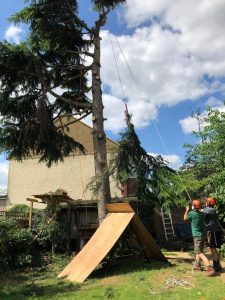

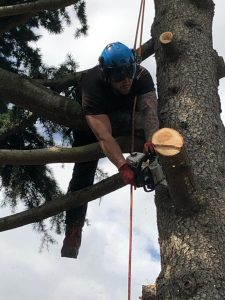
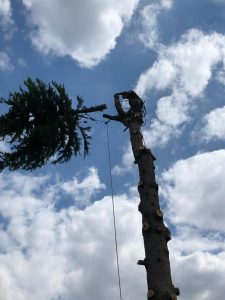

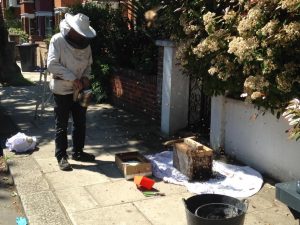 As a Tree Surgeon in London it’s not everyday we need our friends at the
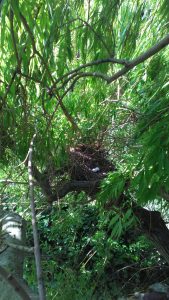 The jobs might get shuffled around during this time of year but it’s a small price to pay in the wider scheme of things. We at Tom Boswell Tree Services, check cavities in trees with great care this time of year. Good thing we did in this tree, since this woodpecker was peacefully living inside!
Woodpeckers tap on tree trunks in order to find insects living in the bark, they also do this to excavate nest cavities. These birds originally eat insects,fruit,acorns and nuts. They are a global creature that are found particularly in wooded areas.
The only places on earth that does not have woodpeckers are Australia and New Zealand. Both male and female woodpeckers help each other to excavate in a tree to incubate (sit on) eggs for two weeks. When the eggs hatch, the woodpeckers are blind and featherless. The new woodpeckers usually leave the nest after 25-30 days.

 Sam and James did a marvellous job on one of the biggest Japanese Maples we’ve seen, in Chiswick, London. Sam had pruned this Maple 3 years ago but judging by the regrowth and vitality of the tree it was certainly planted in a happy place.
It’s always satisfying to get continuity in caring for trees and it was great Sam had the opportunity to return to this Maple.
Japanese Maples are usually small trees that flower in early to mid spring. Most of them grow very slowly. They are perfect in a smaller garden or grown in big containers. Japanese Maples can attain the height of 8-9 meters in fifty years depending on cultivar. These types of tress should be planted in the Autumn and kept in a sheltered area with some sun exposure. They are very easy to maintain, a perfect plant to have in your garden, by your front door or even inside providing it is getting enough light and water.
The perfect type of soil to grow a Japanese Maple tree is moderately acidic, sandy and well drained. These trees will not indulge wet, dry or alkaline conditions. These trees are perfect for growing in a small and compact space, because they tend to have fibrous roots which ensures they are not too crowded.
For more info on Japanese Maple Tree’s,
 Tree Surgery in Richmond, London.
One of our clients has this established Bay tree growing next to the pathway in their back garden in Richmond. Tom Boswell Tree Services re-shaped the tree and pruned it to give it an elegant and sleek look.
A Bay tree is a very popular evergreen shrub that is suitable to grow in either a container or in the ground. It’s leaves can be used for cooking (fresh or dried) to give an extra flavour and fragrance to things like stews, soups and other cooked dishes.
Its common names are Bay Tree, Bay Laurel and Sweet Bay and it flowers in the Spring. A Bay tree can grow up to a maximum of 7.5m (unclipped). It needs a fair amount of sun exposure and partial shade. It can survive in lower temperatures to as low as -5C so long as it is sheltered. Bay is hardier when planted in the ground. It is very easy to maintain and looks perfect for an entrance into your garden or home.
Are you looking for tree surgery and pruning? Find out about our tree